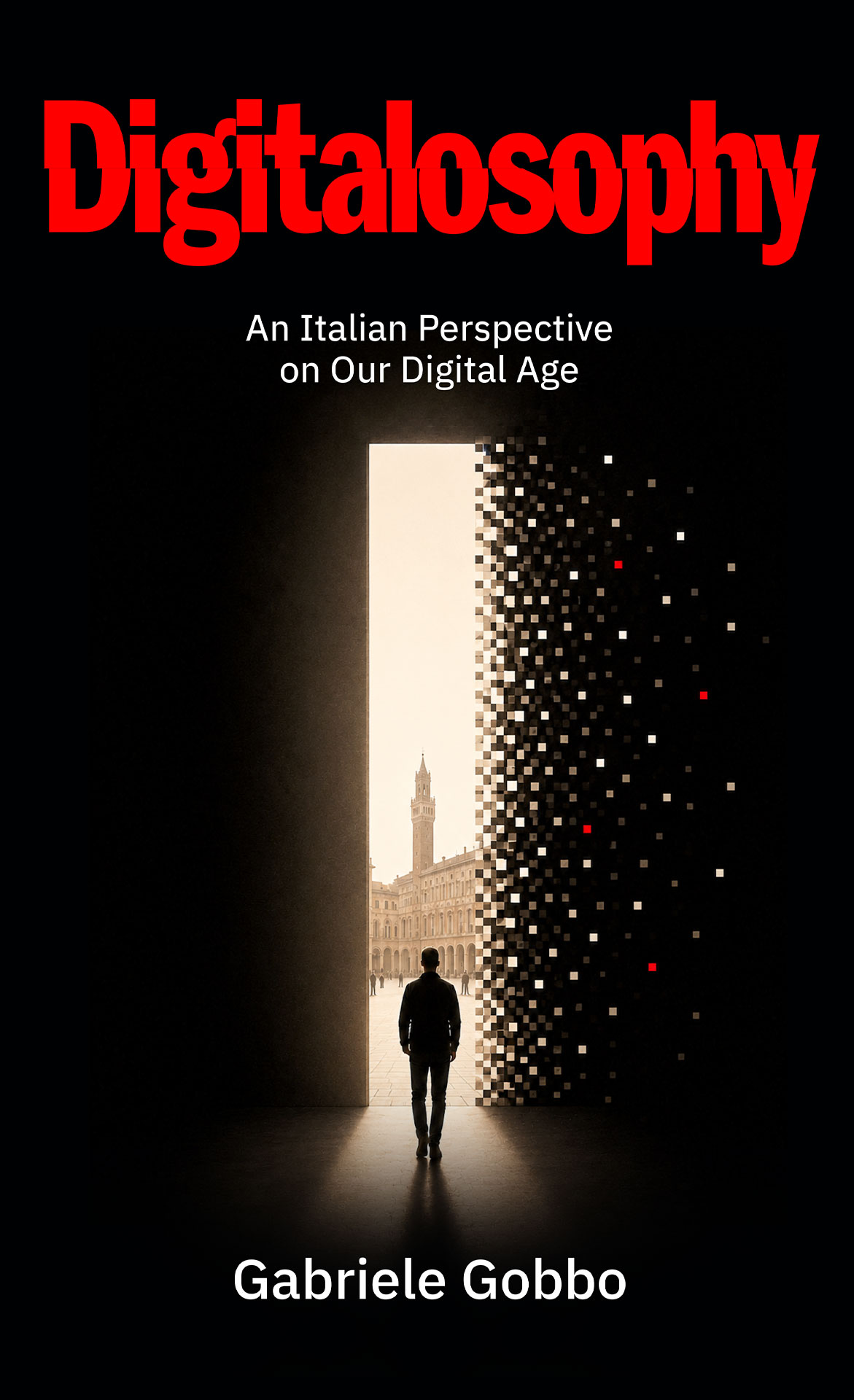
Book at a Glance
About the Book
Short Description
Digitalosophy: An Italian Perspective on Our Digital Age is a book about the digital life we already inhabit every day: platforms, attention, online reputation, social media, cybersecurity, children and screens, and the quiet habits that shape how people live with technology.
Written by Italian author, educator, and researcher Gabriele Gobbo, the book brings thirty years of observation in digital culture to a question most people rarely stop to ask: are we using technology with awareness, or simply adapting to systems we barely understand?
Extended Description
We scroll, post, message, work, teach, buy, search, share, and raise children inside digital systems most people barely understand. These systems shape attention, reputation, trust, relationships, work, education, and everyday behavior. Most people adapt. Few stop to ask what they are adapting to.
Digitalosophy approaches this reality as a human ecosystem. It does not offer a productivity system, a detox program, or a set of behavioral hacks. It offers a way of looking: technology observed from a culture that watched the digital age arrive from a distance, with a different set of questions.
The perspective comes from Italy. The subject is universal. Gobbo writes from Italy, where technology has always had to justify itself to culture, family, and human rhythm. That distance produces observations that are harder to make from inside the conversation.
The book addresses digital communication, online reputation, social media, cybersecurity, advertising, children and screens, and the growing pressure to stay connected at all times. It develops several original concepts, including Digital Sleepwalkers and Social Zombing, and argues for a Back to Home Strategy: the idea that your website is the only digital space you actually own.
Digitalosophy is for people who use technology every day and feel that digital life has become too important to be lived on autopilot.
Author Bios
Gabriele Gobbo is an Italian author and educator with thirty years of experience in digital culture. Creator of Digitalosophy, guest lecturer in Cyber-Humanities at Università Vita-Salute San Raffaele in Milan, Vice President of the Digital Security Festival, and founder of Italiamac, Italy's largest Apple community. Honored with the Divulgatore d'Oro (Golden Communicator) at the MCC Digital Award 2023. Based in Italy, not far from Venice.

Gabriele Gobbo has worked at the intersection of digital culture, media, and education for over thirty years. He is a digital culture author, educator, and researcher who has followed Italy's digital evolution since the early days of personal computing.
In 1996 he founded Italiamac, Italy's largest Apple community, which is still active today. He is the host of FvgTech, a weekly television program on digital culture, and Vice President of the Digital Security Festival, which received the GoBeyond Award in 2025. He is a guest lecturer in Cyber-Humanities at Università Vita-Salute San Raffaele in Milan.
Gobbo is the creator of Digitalosophy, a philosophical framework for critical thinking in the digital age, and the author of books on digital culture, AI, and technology education. His work includes the concepts of Digital Sleepwalkers and Social Zombing, a term he co-created with Max Guadagnoli to describe coordinated digital attacks on personal reputation. His research also includes Synthetic Domestic Abuse, a concept he introduced in 2026 to describe the risk that a smart domestic robot designed to learn from family life may also learn from domestic violence.
He has presented his book Digitalogia at an event held at the Italian Chamber of Deputies, participated alongside Marco Camisani Calzolari in national online safety campaigns for Italy's State Police, and contributed to an expert panel on cyberbullying for Italy's Ministry of Education. In 2023 he received the Divulgatore d'Oro (Golden Communicator) at the MCC Digital Award. His writing appears in Agenda Digitale, one of Italy's leading publications on digital culture and policy.
Based in Italy, not far from Venice.
Editorial Angles
Six story angles, ready to use for articles, interviews, or features.
-
Digital Life Needs Better Words
Digital life keeps creating situations that ordinary language does not name well. The book develops several terms that give editors and readers a more precise vocabulary: Digital Sleepwalkers, Social Zombing, Back to Home Strategy. From the author's wider work, this vocabulary also extends to Synthetic Domestic Abuse, a concept introduced in 2026 around domestic robots, family life, and learned patterns of abuse.
-
The Myth of the Digital Native
Many people know how to use technology, but far fewer understand what technology is doing to their attention, habits, reputation, and relationships. Digital fluency is not the same as digital awareness. A teenager fluent on TikTok is not necessarily fluent in TikTok.
-
Online Reputation Is Not What You Post
Reputation is now shaped inside platforms people do not control. Social Zombing, a term co-created by Gabriele Gobbo and Max Guadagnoli, describes coordinated digital attacks that exploit platform systems to damage personal reputation without the target ever knowing why their account was penalized.
-
Children, Screens, and Adult Responsibility
Children do not need adults who merely keep up with the latest apps. They need adults who understand the digital environment well enough to guide them through it. The real question is not how much time children spend online, but what kind of adults are present when they do.
-
The Italian Perspective on Digital Culture
Digitalosophy brings a perspective shaped outside Silicon Valley: technology observed from Italy, where digital systems have always had to negotiate with culture, family, rhythm, and everyday human life. Thirty years of watching the digital age from a distance produces a different set of questions.
-
Technology Should Serve Human Judgment
The central question Digitalosophy asks is not how to use more tools, but how to remain aware while using the ones that already shape daily life. Technology should serve human judgment, not replace it.
Key Concepts
-
Digitalosophy
The philosophical framework that gives the book its name. A way of approaching technology that starts with the human, not the tool. Not a productivity system. Not a detox program.
-
Digital Sleepwalkers
People who navigate technology with apparent fluency but without real awareness of how the systems around them work. The myth of the digital native assumes that exposure equals understanding. It does not.
-
Children and Screens
Not about banning devices. About the gap between using technology and understanding it. The question is not how much time children spend online, but what kind of adults are present when they do.
-
Disconnecting
On notification stress and what it actually takes to reclaim attention in a world designed to fragment it.
-
Social Zombing
A coordinated digital attack that exploits platform anti-fake systems to penalize a legitimate account. Different from buying fake followers: Social Zombing uses fake signals against someone else, without their knowledge. Co-created by Gabriele Gobbo and Max Guadagnoli (2021).
-
Back to Home Strategy
Your website is the only digital space you actually own. Social media platforms can change the rules, limit your reach, or close your account without warning. Owned infrastructure is not nostalgia. It is strategy.
-
Social Media Has a Price
Being on social media is not free. The platforms are commercial systems, and the idea that showing up is enough stopped being true a long time ago.
-
Cybersecurity Is Not Paranoia
Security is a behavior, not a setting. The book addresses the real vulnerabilities that affect individuals, families, and small businesses every day, in plain language.
Contact
Available for interviews, commentary, and editorial contributions. Review copies and book excerpts available on request. Additional materials including high-resolution images, extended author biography, and editorial angles are included in the press kit download above.